

What Benefits Do Immigrants Get?
Immigrants grease the wheels of the labor market by flowing into industries and areas where there is a relative need for workers — where bottlenecks or shortages might otherwise damp growth.
They also contribute to the economy in other ways. For example, they boost innovation, a key factor in improving living standards.
1. Employment Opportunities
Employment is one of the most important benefits immigrants get, as it provides a means for them to sustain themselves and support their families. It is also essential for them to integrate into their host country’s social fabric. Without work, it’s possible for immigrants to become deprived of social and economic opportunities, leading to severe consequences for their well-being.
Jobs for immigrants in the United States vary greatly depending on their skills and qualifications. For example, some occupations are labor-intensive and require a lot of physical effort, while others have higher salaries.
But many of the positions available to immigrants are entry-level and pay very low wages, especially those that do not require formal education or certifications. For instance, drywall hangers and stucco masons are often immigrants, as are sewing machine operators and farm workers.
Another group of immigrants that find work are those who have little professional experience but do have high levels of skill and qualifications. The demand for such skills is constantly increasing, especially in fields like agriculture and construction.
These jobs are not particularly prestigious but are often good enough to pay well and provide a stable income, notes the BLS. Carpenters and boilermakers, for instance, can earn up to $88,540 annually.
Besides these entry-level positions, immigrants may also choose to specialize in specific professions. For example, they may decide to study a science-related field like engineering or computer programming. But they need to keep in mind that this type of career is not an easy one, since it requires a certain amount of time and effort to acquire the necessary skills. Fortunately, there are organizations like Upwardly Global that can help new arrivals find and get hired in their desired professional field.
2. Education
In 1982, the Supreme Court ruled that all students, regardless of immigration status, have a constitutional right to a free public education from kindergarten through 12th grade. A quality education can help low-income immigrants break the cycle of poverty, build community support and develop the skills they need to contribute to the American economy.
A college degree is an essential tool for immigrants to gain economic mobility and access high-skilled jobs. In 2016, about 17.2% of immigrant ages 25 and older had a bachelor’s degree, while 12.8% had a postgraduate degree.
Increasingly, immigrants are better educated than ever. As a group, they are about as likely as U.S.-born populations to have a bachelor’s or postgraduate degree, though that share varies by country of origin.
Many states have passed tuition equity laws or policies that offer in-state tuition rates to unauthorized immigrant students who graduate from high school or obtain a GED in the state. Some states, like Oklahoma and Rhode Island, have also enacted policies to allow unauthorized immigrant students to receive state-sponsored education grants or financial aid.
However, many undocumented students struggle to complete higher education due to cost constraints, long completion times and the need for work while in school. Additionally, the lack of immigration reform and the fear of deportation keep many students from pursuing their goals for higher education.
NILC works to counter laws that would chill immigrant families’ access to education and supports the DREAM Act, which would provide young people who were brought to the United States as children with a path to citizenship and access to the higher education they need to contribute fully to the nation. NILC has also led the fight to ensure that all youth, including those in deferred action programs, have access to education and are able to pursue their goals for higher learning and careers in the U.S.
3. Health Care
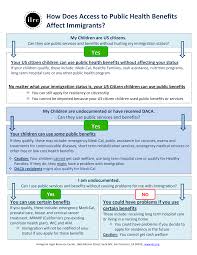
Immigrants, like everyone else, need access to healthcare in order to live healthy lives. This includes preventative care and medical treatment for conditions that may develop or worsen over time.
For adults, Medicaid and the Children’s Health Insurance Program (CHIP) offer free or low-cost health coverage to many individuals and families. The programs provide essential benefits like doctor visits, prescriptions, mental health services and hospitalization.
Some states also have Medicaid and CHIP programs for undocumented immigrants. Those in need of medical care should contact their local health department for information about available options and assistance.
Most states also have public health programs that are free or low-cost to individuals and families. These programs include hospital emergency rooms and free or low-cost dental and vision care.
While the federal government is limiting the number of immigrants that can apply for health insurance through Medicaid and CHIP, it’s not stopping people from applying. In fact, several states have expanded their programs to cover immigrants without a green card or lawful permanent residence.
In California, for example, SB10 enables low-income undocumented immigrants to enroll in MediCal without premium subsidies or co-pays. This legislation has received support from a broad coalition of business and civic groups.
As with the social services that we covered in our earlier section, health care providers must be alert to the impact of their service delivery on their patients’ overall well-being. This is especially true for the mental health of immigrants, whose exposure to stressors from immigration policy can negatively affect their well-being.
As we’ve noted, the ACA made significant changes to the availability of health insurance to immigrant populations. For example, the ACA removed the five-year waiting period for non-citizens to become eligible for Medicaid. It also allowed states to eliminate the waiting period for children and pregnant women. Nevertheless, there is a lot of work to do in building trust and reducing fears among immigrant families about their ability to access services and supports.
4. Social Security
Social Security is a government-operated retirement system that provides income benefits to retired workers and their families. Benefits depend on a person’s work history, earnings level, and age at retirement.
The primary insurance amount (PIA) is computed based on a person’s average lifetime earnings and is adjusted for price inflation. The PIA is then used to determine a monthly benefit amount. The PIA is indexed for future price inflation so that the monthly benefit amount retains its purchasing power throughout a person’s retirement years.
Unlike other public benefits, which may be subject to means testing, Social Security is not. Therefore, immigrants are eligible to receive social security benefits if they meet all other eligibility requirements.
While many Americans rely on Social Security to support themselves, a growing number of immigrants are also receiving benefits. Immigrants can become eligible for benefits after they meet a number of criteria, including meeting the minimum work requirements, contributing enough into the program, and having a legal resident dependent who is also working and paying into the program.
Some of these immigrants are sponsored by citizens or legal permanent residents who have petitioned for them to immigrate. In these cases, the sponsors will often sign an affidavit of support that agrees to pay a fixed amount of money to the immigrant until he or she becomes a citizen or accumulates 40 quarters of work with Social Security.
Undocumented immigrants currently contribute about $13 billion a year into the Social Security trust funds and are expected to contribute more in the future. Providing legal status and a pathway to citizenship for all 11 million undocumented immigrants would have a substantial positive impact on the long-term solvency of Social Security.
5. Taxes
In the US, immigrants can receive several benefits from government programs. For example, many immigrants have access to free public housing.
Immigrants also may be able to use tax credits and deductions that can reduce their taxes. They can get assistance with health care and education costs, too.
But, these benefits are not necessarily available to all immigrants. Some immigrants are not employed or they have less education than the native-born population.
If these immigrants do not have Social Security numbers, they can get an Individual Taxpayer Identification Number (ITIN). This is a 9-digit number that can be used for noncitizens to pay federal income taxes on money earned in the United States.
These ITINs can help improve the IRS’s ability to collect taxes and deliver targeted anti-poverty benefits. They can even help make the Social Security system more solvent.
One study found that undocumented immigrants paid $13 billion in payroll taxes in 2013, boosting the retirement fund for the Social Security Administration.
Another study, published in 2017, estimated that immigrants contributed $50.2 billion to the government between 2012 and 2016. They also contributed more than the cost of their care ($18.5 billion). The researchers also analyzed the total impact of immigrant contributions on welfare programs.
In the UK, a recent study estimates that new migrants to the UK provide a net fiscal benefit on an annual basis. This is primarily due to the fact that they tend to be younger and more educated than the native-born population.
However, this effect is not likely to be large enough to offset the long-term fiscal shortfall that would occur if immigrants were not welcomed. This is because immigrants, no matter how different from the native-born population they are, cannot collectively impose much of a net tax burden or bestow much of a benefit if they represent only a small share of the population.